Antimicrobial resistance (AMR) is one of the most pressing challenges in modern veterinary medicine. To strengthen surveillance, harmonisation, and evidence‑based antimicrobial stewardship, the University of Liverpool leads VetCLIN AMR, a major research initiative focused on clinical infections in companion animals and equines.
The programme integrates diagnostic data from veterinary microbiology laboratories, develops harmonised testing methodologies, and provides practical tools to improve AMR monitoring across the UK and beyond.
🐾 What Is VetCLIN AMR?
VetCLIN AMR is a multi‑year project partnering with veterinary microbiology laboratories to:
- Integrate diagnostic data into national AMR surveillance
- Harmonise antimicrobial susceptibility testing (AST) methodologies
- Improve comparability of laboratory results
- Support better antimicrobial stewardship in clinical practice
The project is funded by the Veterinary Medicines Directorate (VMD) under the Private Laboratory Initiative and collaborates with multiple UK and European partners.
🧪 Key Components of the Programme
1. Methodology Harmonisation Toolkit
VetCLIN AMR provides a publicly accessible toolkit that consolidates AST interpretation guidance from major sources such as CLSI Vet01, CLSI M100, CLSI VET09, and EUCAST. It helps laboratories navigate situations where clinical breakpoints are missing and supports harmonised decision‑making.
2. Proficiency Testing Scheme (Free Participation)
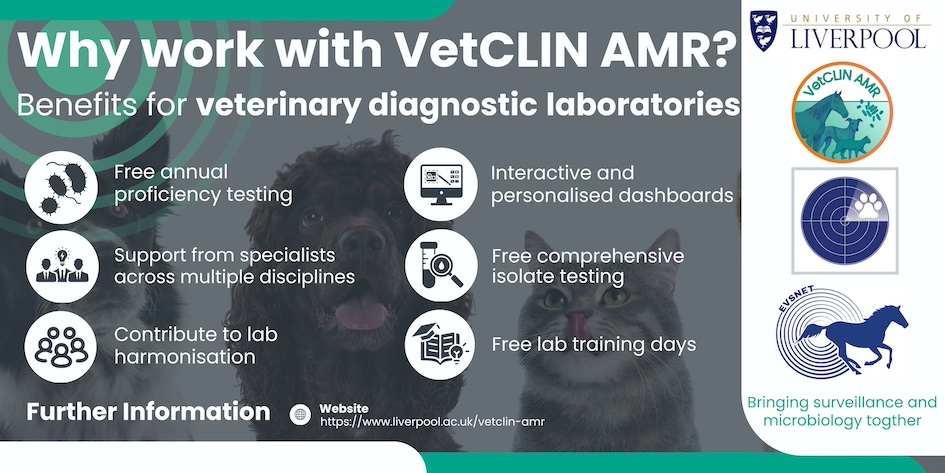
The programme offers free proficiency testing for veterinary laboratories processing companion animal and equine samples. Participants receive:
- Personalised feedback
- Benchmarking tools
- Support from veterinary microbiology specialists
These schemes strengthen data quality and contribute to national and international AMR surveillance efforts.
3. Training Resources & Protocol Archives
VetCLIN AMR hosts training materials and the Companion Animal Microbiology Protocols (CAMiProt) archive, supporting continuous professional development for vets, nurses, and laboratory staff.
🌍 Research Impact & One Health Relevance
The University of Liverpool’s wider AMR research explores:
- Transmission of ESKAPE organisms in veterinary hospitals
- Genomic epidemiology of AMR in companion animals
- Links between animal and human AMR strains in the UK
This One Health approach helps identify shared lineages and transmission pathways between pets, people, and environments.
📌 Why This Matters for Veterinary Professionals
VetCLIN AMR provides:
- Evidence‑based tools to improve antimicrobial prescribing
- Harmonised laboratory methodologies
- Better surveillance data for clinical decision‑making
- Training resources for vets and microbiologists
- Opportunities to participate in national AMR monitoring
It is a cornerstone initiative for improving AMR understanding in real clinical settings.
🔗 Access the VetCLIN AMR Programme
Full details, resources, and participation options are available here: https://www.liverpool.ac.uk/infection-veterinary-and-ecological-sciences/research/vetclin-amr/